

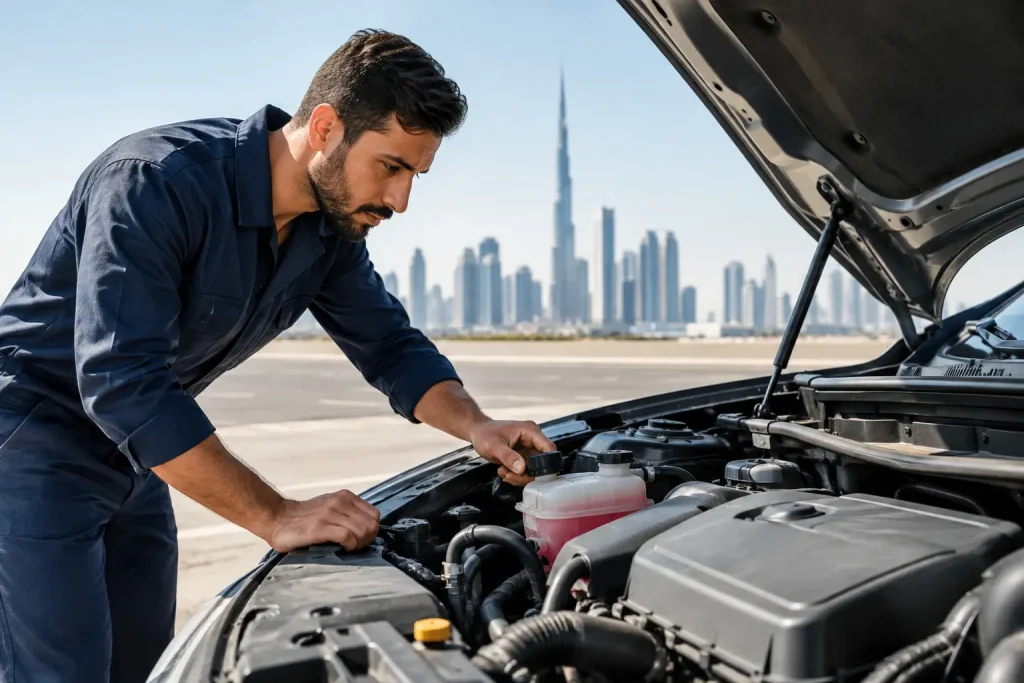
A temperature gauge climbing past its normal position is not a warning to ignore until your next service. In Dubai traffic and summer heat, a cooling system can move from slightly stressed to seriously overheated quickly. Knowing how to prevent engine overheating protects more than your commute – it can prevent warped cylinder heads, damaged gaskets, and repair bills that grow far beyond a routine service.
Your engine creates a huge amount of heat every time it runs. The cooling system manages that heat through coolant, the radiator, hoses, water pump, thermostat, fans, and sensors. When one of these parts is low on fluid, blocked, leaking, worn, or not operating correctly, the system loses its margin for error. High ambient temperatures, stop-and-go traffic, and hard air-conditioning use make that margin even smaller.
Start With the Correct Coolant Level
Coolant is not simply colored water. It is a carefully mixed fluid that transfers heat, resists boiling, protects metal components from corrosion, and helps prevent freezing in colder climates. In Dubai, its high-temperature protection and anti-corrosion properties are especially relevant.
Check the coolant reservoir only when the engine is completely cool. The level should sit between the minimum and maximum marks. If it is repeatedly low, do not keep topping it up and assume the problem is solved. Coolant does not normally disappear. A falling level can point to a leaking hose, radiator, expansion tank, water pump, radiator cap, or an internal engine issue.
Use the coolant type and mixture specified for your vehicle. German and American vehicles can have different coolant specifications, and mixing incompatible formulas can reduce corrosion protection or create deposits in the system. Plain water may help in a genuine roadside emergency, but it should not become a long-term substitute for the correct coolant mix.
Keep Up With Cooling-System Service
A routine oil change alone does not confirm that your cooling system is healthy. During scheduled servicing, ask for the radiator, hoses, clamps, belts, coolant condition, and reservoir to be inspected. A pressure test is often the fastest way to identify small leaks that may not leave a visible puddle on the ground.
Coolant also has a service life. Over time, its protective additives wear down and contamination can build up. The right replacement interval depends on the vehicle manufacturer, coolant type, mileage, and age of the car. Flushing coolant too often is unnecessary, but leaving old coolant in place for years can encourage corrosion inside the radiator and engine passages.
The radiator cap deserves attention as well. It maintains the system pressure that raises coolant’s boiling point. A weak cap is inexpensive compared with major cooling repairs, yet it can contribute to overheating under load. It is a small component with a big role.
Make Sure Air Can Move Through the Radiator
The radiator cannot release heat if airflow is restricted. Leaves, plastic bags, sand, insects, and road debris can collect between the radiator and air-conditioning condenser. External blockage is particularly common where dust and sand are part of daily driving conditions.
A technician can inspect and clean the cooling stack safely without bending the delicate fins. Avoid attacking the radiator with excessive water pressure, as damaged fins can restrict airflow further. If the front bumper has been repaired, modified, or fitted with accessories, it is also worth checking that nothing is obstructing the air path.
Electric cooling fans matter most when the car is stationary or moving slowly. If your temperature rises in traffic but falls again once you reach highway speed, a faulty fan, relay, fuse, wiring issue, or temperature sensor may be involved. This is not a problem to diagnose by replacing parts at random. Proper electrical testing can identify whether the fan is being commanded on and whether it is actually receiving power.
Watch the Thermostat, Water Pump, and Drive Belt
Some overheating faults develop gradually, while others appear without much warning. A thermostat that sticks closed can prevent coolant from circulating through the radiator. A failing water pump may leak, make noise, or lose its ability to circulate coolant properly. On vehicles with belt-driven pumps, a worn or damaged drive belt can create the same result.
These parts are usually checked during a professional diagnosis rather than a quick visual inspection. The technician may look at live temperature readings, cooling fan operation, pressure behavior, coolant flow, and fault codes before recommending a repair. That approach matters because the same dashboard warning can come from several different causes.
For vehicles with a history of overheating, do not assume replacing the thermostat alone will fix everything. The original heat event may have damaged a hose, weakened a plastic fitting, exposed a failing fan, or affected the head gasket. A complete assessment avoids paying twice for related repairs.
How to Prevent Engine Overheating While Driving
Good maintenance does most of the work, but driving habits still matter when temperatures are extreme. Avoid prolonged idling where possible, especially if the temperature gauge is already higher than normal. If you are towing, carrying a heavy load, climbing steep grades, or driving aggressively in hot weather, pay closer attention to the gauge than usual.
Air conditioning adds load to the engine and places additional demand on the cooling system. A healthy vehicle should handle normal air-conditioning use without overheating. If the temperature begins to climb while the AC is running, switch it off temporarily and reduce engine load, but treat that as a warning sign that needs inspection rather than a permanent workaround.
Never rely only on the gauge. Many newer vehicles keep the needle in the middle until coolant temperature is already outside its ideal range. A warning message, reduced engine power, a sweet coolant smell, steam from under the hood, or a heater that suddenly blows cold can all indicate a cooling problem.
What to Do If Your Engine Starts Overheating
If the temperature warning appears, turn off the air conditioning, ease off the accelerator, and find a safe place to stop as soon as possible. Do not continue driving just to reach home or the workshop if the gauge is in the red or steam is visible. A short extra distance can turn a manageable repair into engine damage.
Once safely stopped, turn off the engine and allow it to cool fully. Do not open the radiator cap or coolant reservoir while hot. Pressurized coolant can spray out and cause serious burns. Do not pour cold water onto a hot engine, either, as sudden temperature changes can damage components.
After the engine has cooled, you can look for obvious leaks beneath the vehicle or around the engine bay, but avoid touching hot parts. If coolant is low or a warning returns after restarting, arrange recovery instead of driving further. The cause needs to be found before the car is put back into regular use.
Do Not Ignore Repeat Warnings
An overheating warning that disappears is still a warning. Intermittent faults often show up first during heavy traffic, long highway runs, or the hottest part of the day. Waiting until the issue becomes constant can leave you stranded and increase the risk of damage to the engine.
At HYATTS AUTO CARE, cooling concerns should be approached with inspection and testing, not guesswork. A clear diagnosis helps you understand whether the problem is a simple leak, a fan-control fault, a worn pump, or a larger mechanical issue, along with the repair work that is genuinely needed.
A well-maintained cooling system is quiet protection: you should not have to think about it on every drive. Check fluid levels when the engine is cold, follow the correct service schedule, and act early when the temperature behavior changes. That is the most practical way to keep your car dependable when the heat is working against it.