

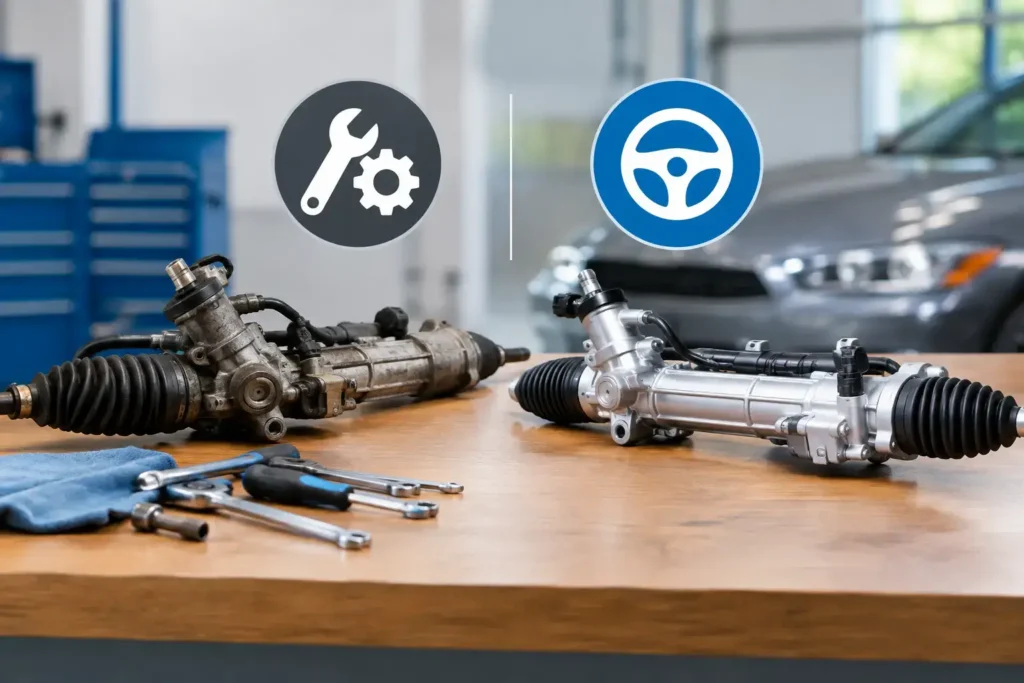
A steering wheel that suddenly feels heavy, pulls inconsistently, or displays a power steering warning should never be treated as a minor inconvenience. Electric steering repair versus replacement is a decision that affects safety, driving confidence, and cost. The right answer depends on the fault itself, not simply the age of the vehicle or the first estimate you receive.
Modern electric power steering systems are highly capable, but they combine mechanical components, electronic controls, wiring, sensors, and software. A proper diagnosis can often identify a repairable issue before a complete steering rack or column is condemned. That is where an experienced independent workshop can make a real difference.
How Electric Power Steering Works
Electric power steering, often called EPS, uses an electric motor to assist your steering input. Depending on the vehicle, the motor may be mounted on the steering column, the pinion, or the steering rack. A control module reads information from sensors, including steering angle, steering torque, vehicle speed, and sometimes wheel-speed data, then adjusts the level of assistance.
At low speeds, such as parking in a tight Dubai garage, the system provides more assistance. At highway speeds, it reduces assistance to give the steering a more controlled feel. The system may also communicate with stability control, lane-assist, and driver-assistance features.
This design eliminates the hydraulic pump, belt, fluid reservoir, and fluid leaks associated with older power steering systems. However, it means a steering complaint can originate from electrical, electronic, mechanical, or software-related causes. Replacing the entire unit without testing these areas can be unnecessarily expensive.
Signs Your Electric Steering Needs Attention
The most obvious warning is a heavy steering wheel, especially at parking speeds. You may notice that assistance comes and goes, the steering suddenly becomes stiff after starting the car, or it changes noticeably after driving over a bump. A power steering warning light, steering wheel warning symbol, or message on the dashboard also deserves prompt attention.
Other symptoms are less direct. A clicking or knocking noise while turning may point to a worn steering-column component, coupler, or rack issue. A steering wheel that does not return smoothly after a turn can be caused by binding mechanical parts, incorrect alignment, suspension wear, or an EPS fault. If the wheel feels off-center or the vehicle drifts, the problem may involve alignment or suspension rather than the electric steering motor itself.
Voltage problems matter too. A weak battery, charging-system fault, corroded ground, or damaged wiring can reduce or disable electric steering assistance. This is why a quick scan alone is not enough. Stored fault codes tell a technician where to investigate, but they do not always identify the failed part.
Electric Steering Repair Versus Replacement: The Real Choice
Repair is usually the better route when the fault is isolated to a serviceable part and the main steering assembly remains structurally sound. Replacement becomes the sensible choice when the rack, column, motor, or internal electronics have suffered damage that cannot be repaired reliably.
A repair may involve correcting a power supply or ground fault, repairing damaged wiring, replacing a steering-angle or torque sensor, refurbishing an electric steering motor, replacing a worn coupling, or resolving a control-module issue. Some systems also require software programming, calibration, or steering-angle reset after work is completed.
Replacement may be needed when there is severe internal rack wear, water damage inside electronic components, a failed motor that cannot be refurbished, cracked mounting points, accident damage, or repeated faults after verified repair attempts. On some vehicles, the motor, module, and rack are supplied as one assembly, which limits individual component replacement. Parts availability and manufacturer design play a role.
The key is not to assume that replacement is automatically safer. A correctly diagnosed, professionally completed repair can be safe and dependable. Equally, a low-cost repair is not the right answer if internal damage has compromised the assembly. The goal is a lasting repair based on evidence.
When Repair Makes Financial Sense
Repair generally makes sense when the steering issue is external to the main rack or column assembly. For example, a damaged connector, poor ground connection, worn steering coupler, failed sensor, or charging-system problem may create symptoms that feel like a major steering failure. Addressing the actual cause can save significant money and avoid replacing good parts.
Refurbishment can also be a practical option for certain electric power steering units. The assembly is removed, inspected, rebuilt where appropriate, and tested before refitting. This can be especially valuable on German and American vehicles, where new dealer-supplied steering assemblies can be costly.
However, refurbishment quality matters. The unit must be assessed for mechanical wear, electronic integrity, and proper operation. It must also be installed correctly, followed by calibration and a road test. A repair that skips these steps can leave warning lights, poor steering feel, or safety-system errors.
When Replacement Is the Better Investment
Replacement is often the better long-term value if the steering rack has excessive internal play, a bent housing, significant accident damage, or a non-serviceable electronics failure. It may also be the only reasonable option if water has entered the module or motor and corrosion has spread through the unit.
A replacement unit should not be fitted as a guess. Before installation, the workshop should confirm battery health, alternator output, wiring condition, fault codes, and communication with related modules. Otherwise, the original electrical problem can damage or disable the replacement part as well.
After replacement, many vehicles require coding, steering-angle calibration, alignment verification, and an extended road test. This is particularly important on cars with lane-keeping assistance, adaptive headlights, stability control, or advanced driver-assistance systems. The vehicle may drive, but it is not fully repaired until these systems are checked and reset correctly.
What a Proper EPS Diagnosis Should Include
A transparent electric steering diagnosis starts with the driver’s concern. Does the steering become heavy only when hot? Does the warning appear after rain? Was there recent battery work, body repair, suspension work, or an impact with a curb? These details help narrow the investigation.
The technician should then perform a visual inspection and electronic scan, followed by electrical testing. Battery condition and charging voltage are checked first because EPS systems can be sensitive to low voltage. Wiring, connectors, fuses, grounds, steering and suspension components, and rack mountings are inspected for damage or looseness.
Live data can reveal whether steering torque, angle, motor demand, and vehicle-speed signals are behaving correctly. A road test may be necessary to reproduce an intermittent fault. If replacement is recommended, you should be able to understand why the existing part cannot be repaired with confidence.
At HYATTS AUTO CARE, that approach means explaining the findings in straightforward language before major work begins. You should know whether the issue is a repairable electrical fault, a mechanical steering concern, or an assembly that genuinely needs replacement.
Avoid These Costly Shortcuts
Do not ignore an intermittent steering warning simply because the assistance returns after restarting the vehicle. Intermittent faults can become permanent, and a sudden loss of power assistance makes low-speed maneuvering much harder. If the steering is unusually heavy or unpredictable, arrange an inspection promptly rather than continuing to drive normally.
Avoid fitting a used steering rack or column without checking compatibility, part numbers, and programming requirements. A used component may carry the same hidden defect, have incompatible software, or require coding that has not been completed. The upfront saving can disappear quickly if the fault returns.
It is also wise to be cautious with any estimate that recommends a complete steering assembly before basic voltage, wiring, sensor, and mechanical checks have been completed. Clear diagnosis protects your budget as much as it protects your car.
Choosing the Right Fix for Your Car
There is no universal answer to electric steering repair versus replacement. A newer vehicle with an isolated sensor or wiring problem may need a focused repair. A vehicle with internal rack damage or failed non-serviceable electronics may need a replacement assembly and calibration. The best decision considers safety, the confirmed fault, parts availability, vehicle condition, and the cost of doing the job correctly.
If your steering feels different, do not wait for the problem to become a roadside inconvenience. A careful inspection can separate a manageable repair from a larger failure and give you a clear, fair path forward.