

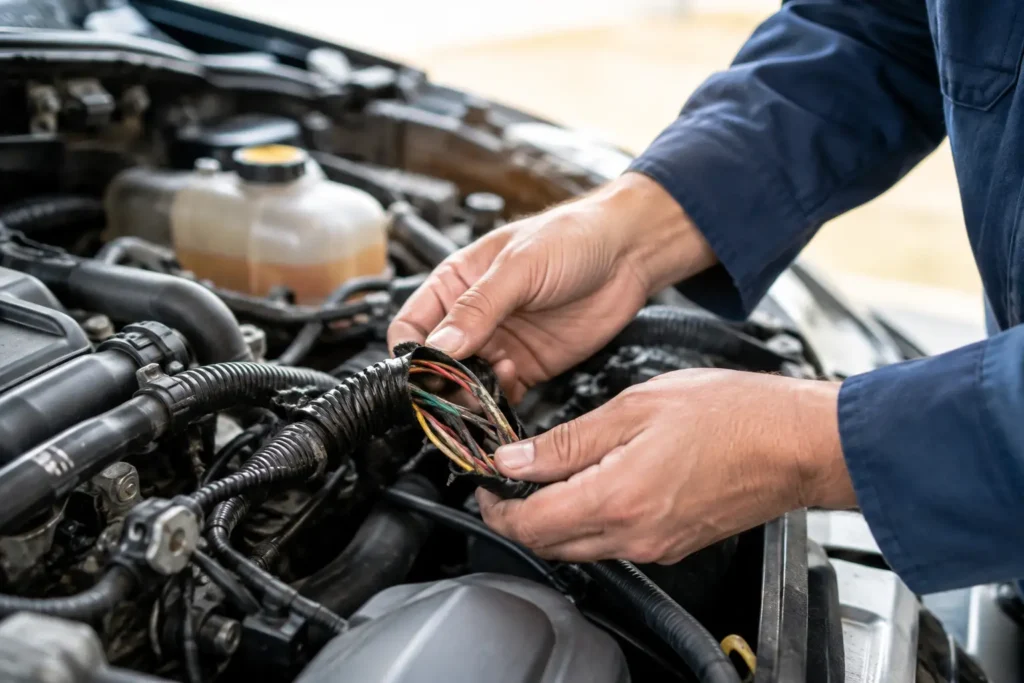
A vehicle can have a healthy battery, a working starter, and plenty of fuel, yet still refuse to start because one damaged wire is interrupting the circuit. Automotive wiring repair is not just about replacing a visible broken cable. It is about finding the exact point where power, ground, or communication has been lost – then repairing it properly so the fault does not return.
For Dubai drivers, electrical faults can become especially frustrating. Heat, dust, age, previous repairs, moisture from washing, and damaged insulation can all affect wiring over time. A proper diagnosis saves time, avoids unnecessary parts replacement, and gives you a clear answer about what your vehicle actually needs.
When automotive wiring repair may be needed
Electrical problems do not always appear as a dramatic breakdown. Often, they begin with small changes that are easy to ignore: a warning light that comes and goes, a reverse camera that works only sometimes, headlights that flicker, or a window switch that responds after several attempts.
A no-start condition is one of the clearest warning signs, but it is not the only one. You may also notice blown fuses, a battery that drains overnight, dashboard messages with no obvious mechanical issue, erratic central locking, or an air conditioning blower that cuts in and out. On modern German and American vehicles, a damaged wire or poor connection can also affect communication between control modules, creating several fault messages at once.
The key point is that these symptoms can look like failed components. A faulty sensor code, for example, does not always mean the sensor itself has failed. The wiring, connector, ground point, or control module circuit must be tested before replacing parts.
Why wiring faults are often misdiagnosed
A damaged wire is rarely as obvious as a snapped cable under the hood. Wiring looms run behind dashboards, through door hinges, beneath carpets, around the engine bay, and near suspension components. The damage may be hidden inside insulation, beneath a connector seal, or in a section of loom that has rubbed against metal over thousands of miles.
Some workshops replace the component named in a diagnostic code without checking the circuit that supports it. That can lead to an expensive cycle of new sensors, modules, or switches while the original wiring issue remains. A scanner is useful, but it is the starting point, not the final diagnosis.
Professional electrical diagnosis combines scan-tool data with voltage-drop testing, continuity checks, load testing, wiring diagrams, and physical inspection. This process takes skill because a circuit can appear normal with no load applied, then fail when a motor, relay, or module demands current.
Heat, vibration, and previous repairs all matter
Engine-bay wiring faces constant heat cycles and vibration. Over time, insulation can become brittle, terminals can loosen, and connectors can corrode. Wiring near the battery, alternator, ignition coils, cooling fans, and sensors deserves particular attention.
Door wiring is another common trouble area. Every time a door opens and closes, the wires in the flexible rubber boot move. Eventually, repeated flexing can break conductors internally. The result may be an intermittent power window, speaker, mirror, door lock, or warning light.
Previous accident repairs, accessory installations, and poorly completed modifications can also create faults. Non-factory wiring for lights, audio equipment, cameras, alarms, or trackers should be installed with correct fusing, routing, insulation, and connectors. A quick twist-and-tape repair may work temporarily, but it is not a reliable long-term solution.
What a proper wiring repair looks like
Good automotive wiring repair begins by confirming the complaint. If a customer reports an intermittent no-start, for example, the technician needs to know when it happens: after parking in heat, after rain, when turning the steering wheel, or only after the vehicle has been driven. Details like these help narrow down the circuit involved.
The affected system is then scanned and tested. The technician checks power supply, ground quality, fuse condition, relay operation, signal integrity, and connector fitment before condemning a component. Where required, the wiring is traced through the vehicle using manufacturer diagrams and appropriate test equipment.
Once the damaged area is located, the repair method depends on the wire’s function and location. A quality repair may involve replacing a corroded terminal, installing a correct repair wire, soldering and sealing a connection where appropriate, or replacing a damaged connector or loom section. The repaired area must be insulated, secured, and routed away from heat, sharp edges, and moving parts.
Afterward, the circuit should be retested under normal operating conditions. If the issue involved a stored fault code, the vehicle should be scanned again to confirm the fault does not return. This final verification is what separates a lasting repair from a temporary fix.
Do not ignore a burning smell or repeated blown fuse
Some electrical symptoms require immediate attention. If you smell burning plastic, see smoke, find melted insulation, or repeatedly replace the same fuse, stop using the affected system and arrange an inspection. Replacing a fuse without finding the cause can allow a short circuit to continue damaging the wiring.
A fuse is designed to protect the circuit. When it blows, it is responding to excess current. The cause may be a chafed wire touching metal, water inside a connector, a seized motor, or an incorrect aftermarket installation. Installing a larger fuse to stop it from blowing can overheat the wiring and create a genuine fire risk.
Battery drain also deserves prompt investigation. A weak battery is sometimes simply old, but a vehicle that repeatedly has a flat battery may have an electrical draw after it is switched off. Finding that draw requires measured testing, not guesswork. The cause could be a module that fails to sleep, a faulty relay, wiring damage, or an accessory drawing power when it should not.
The cost depends on access and diagnosis
There is no honest one-price answer for vehicle electrical work. Repairing a visible battery cable or connector may be straightforward. Tracing an intermittent fault inside a dashboard, door loom, or engine harness can take longer because access and testing are part of the job.
The best approach is transparent diagnosis first. You should know what fault has been found, which tests support that finding, what repair is recommended, and whether there are options. In some cases, repairing a local section of wiring is sensible. In others, a heavily damaged loom or connector assembly may need replacement for reliability.
At HYATTS AUTO CARE, electrical work is approached with the same practical standard as mechanical repairs: identify the cause, explain the required work clearly, and avoid replacing parts that have not been proven faulty. That is especially valuable for complex German and American vehicles, where electrical systems can be closely linked.
How to reduce future wiring problems
You cannot prevent every electrical fault, but a few habits help. Keep the battery terminals clean and secure, address water leaks before they reach carpets or control modules, and avoid unqualified accessory installations. If rodents have damaged wiring, have the affected areas inspected fully rather than repairing only the most visible section.
Regular servicing also provides an opportunity to spot loose battery connections, brittle insulation, damaged underbody wiring, and signs of fluid contamination. If a warning light appears occasionally, mention it before it becomes constant. Intermittent faults are often easier to trace while their pattern is still clear.
When your car starts behaving unpredictably, do not accept vague explanations or repeated part swaps. A careful electrical inspection can turn an annoying mystery into a defined repair – and help keep your vehicle dependable on every drive.