

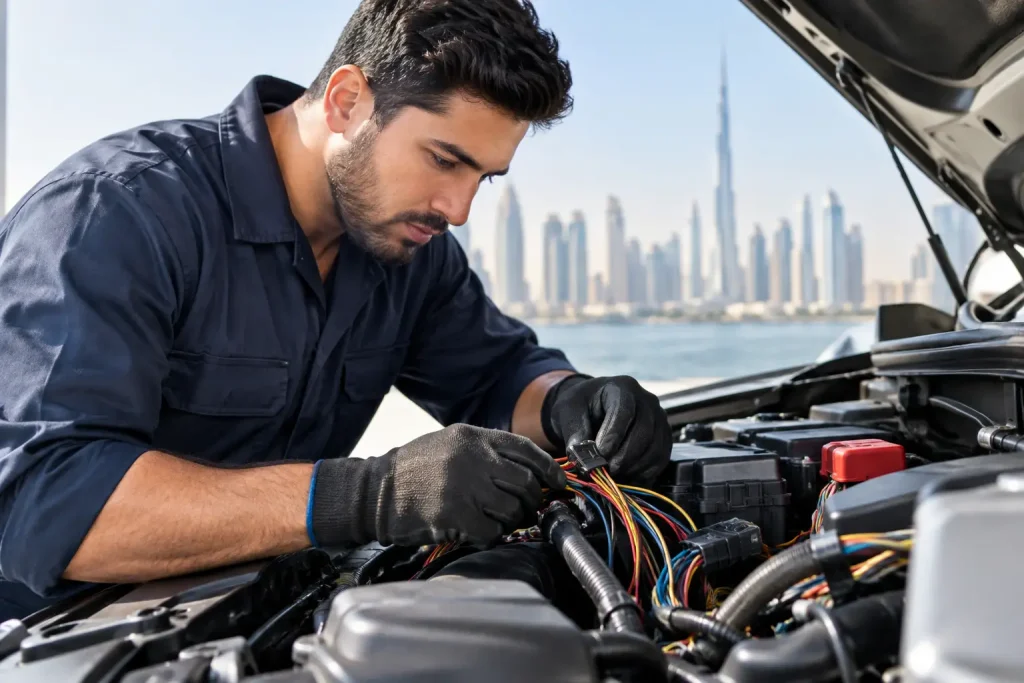
A warning light that appears and disappears, a battery that keeps going flat, or a window that stops working without warning can point to the same underlying issue: damaged vehicle wiring. Car wiring repair Dubai is not simply about replacing a fuse or reconnecting a loose wire. Modern vehicles depend on complex electrical networks, and an accurate diagnosis is the difference between fixing the real fault and paying for parts that never needed replacing.
For Dubai drivers, electrical problems can be especially frustrating. Your car may seem fine on the morning commute, then refuse to start after sitting in the heat. The right repair starts with testing, clear communication, and a workshop that understands how electrical systems behave across different makes and models.
When Your Car May Need Wiring Repair
Electrical faults do not always cause a complete breakdown. Often, they begin as small and inconsistent problems that become more frequent over time. If you notice one isolated issue, it may be a component failure. If several unrelated systems start acting up, wiring, grounding, or a control module connection deserves closer attention.
Common signs include:
- Headlights, cabin lights, or dashboard lights that flicker or dim
- A battery that drains despite being recently replaced or tested
- Windows, mirrors, central locking, or seat controls that work intermittently
- Warning lights for ABS, airbags, engine management, or steering that return after being cleared
- Burning smells, melted insulation, blown fuses, or visible corrosion around battery terminals
- A no-start condition, especially when the battery and starter motor appear healthy
These symptoms are not always caused by wiring. A weak alternator, failing battery, faulty sensor, or damaged control unit can produce similar behavior. That is why replacing parts based on a warning light alone is a costly gamble.
Why Electrical Faults Are Common in Dubai
Heat is hard on every electrical connection. High under-hood temperatures can make insulation brittle, weaken connector seals, and expose existing damage in older harnesses. Battery terminals and ground points can also corrode, especially when moisture, dust, or previous fluid leaks are involved.
Rodent damage is another issue that should not be overlooked. A parked vehicle with chewed insulation may develop a short circuit, sensor failure, or intermittent fault that only appears after vibration or heat affects the damaged section. Accident repairs, aftermarket accessories, and previous low-quality repairs can also leave behind poorly joined wires or incorrect fuse connections.
German and American vehicles often have sophisticated control systems, multiple communication networks, and modules spread throughout the vehicle. This does not make them unreliable by default, but it does mean electrical diagnosis must be methodical. A fault in one circuit can sometimes trigger warnings in systems that are not directly at fault.
How Professional Car Wiring Repair in Dubai Should Work
A proper electrical repair begins with listening to the driver. Details matter: when the problem occurs, whether it happens after rain or washing, if it appears while turning, and whether accessories were installed recently. These observations help narrow down the testing process.
The technician should then check the vehicle’s battery condition, charging voltage, fuse boxes, visible harness routes, connectors, and ground points. Diagnostic scanning is useful, but fault codes are clues, not final answers. A code may identify a circuit with an abnormal reading without proving that the sensor, module, wire, or connector is the cause.
From there, targeted electrical testing can identify voltage drops, open circuits, short circuits, resistance issues, and communication failures. In practical terms, this means tracing the affected circuit and confirming where power, ground, or signal is being lost. For intermittent faults, the vehicle may need to be tested while components are operated or wiring sections are carefully moved.
Once the problem is confirmed, the repair should match the damage. A corroded terminal may only need professional cleaning and protection. A broken wire may require a correctly sized repair section and a sealed connection. A heat-damaged or accident-damaged harness may need a larger section replaced. The best option depends on the condition, location, and importance of the circuit.
Why Quick Fixes Can Create Bigger Problems
Tape wrapped around exposed wire, an oversized fuse, or an improvised connector can turn a small repair into a safety risk. An oversized fuse may allow excessive current to flow before it blows, increasing the chance of melted wiring or damage to an expensive module. Twisted wires without proper sealing can corrode and fail again, particularly in areas exposed to moisture or engine heat.
Aftermarket accessories also need careful installation. Dash cameras, parking sensors, lighting upgrades, audio equipment, and tracking devices should be connected with the correct fuse protection and wiring method. Tapping into the wrong circuit can lead to battery drain, warning lights, or module communication issues.
A professional repair is not always the cheapest initial option, but it is often less expensive than repeatedly replacing batteries, sensors, or modules while the real wiring fault remains. Good workmanship protects the vehicle’s reliability and helps preserve its resale value.
What Affects the Cost of Wiring Repairs?
There is no honest fixed price for every electrical fault because the diagnosis is often the most important part of the job. A loose battery ground can be resolved quickly. Finding an intermittent short inside a dashboard harness or repairing accident damage across multiple circuits can take significantly longer.
Cost usually depends on access, the amount of testing required, the location of the damaged wiring, and whether connectors, terminals, harness sections, or electronic modules need replacement. Vehicles with tightly packed engine bays or complex interior trim may require more labor to access the affected area. Genuine parts may be the right choice for certain connectors and modules, while quality repair materials can be suitable for a localized wire repair.
The key is transparency. Before major work begins, you should understand what has been found, what repair is recommended, and whether there are alternative options. If a workshop cannot explain the fault in straightforward terms, ask for clarification before approving expensive electrical work.
Choosing the Right Workshop for Electrical Diagnosis
The workshop you choose should have more than a diagnostic scanner. It should have technicians who can interpret test results, trace circuits, and repair wiring to a reliable standard. This matters particularly for vehicles with repeated warning lights, parasitic battery drains, steering faults, or electronic problems that another garage has not resolved.
Look for a workshop that checks the basics before recommending costly parts and keeps you informed as the diagnosis develops. Clear updates are especially valuable when a fault is intermittent, because testing may reveal additional information after the vehicle has been inspected or driven.
At HYATTS AUTO CARE, electrical diagnosis is approached as a repair process, not a parts-selling exercise. The goal is to identify the cause, explain the work clearly, and complete the repair with dealership-level care without dealership-level pricing.
Do Not Ignore a Small Electrical Warning
A flickering light or occasional warning message may feel easy to postpone, but electrical faults rarely become more convenient with time. A small connection issue can become a no-start problem, a battery drain, or a failure in a safety-related system when you need the vehicle most.
If your car is showing inconsistent electrical behavior, arrange an inspection before the fault leaves you stranded. A careful diagnosis now can protect your time, your budget, and your confidence every time you turn the key.