

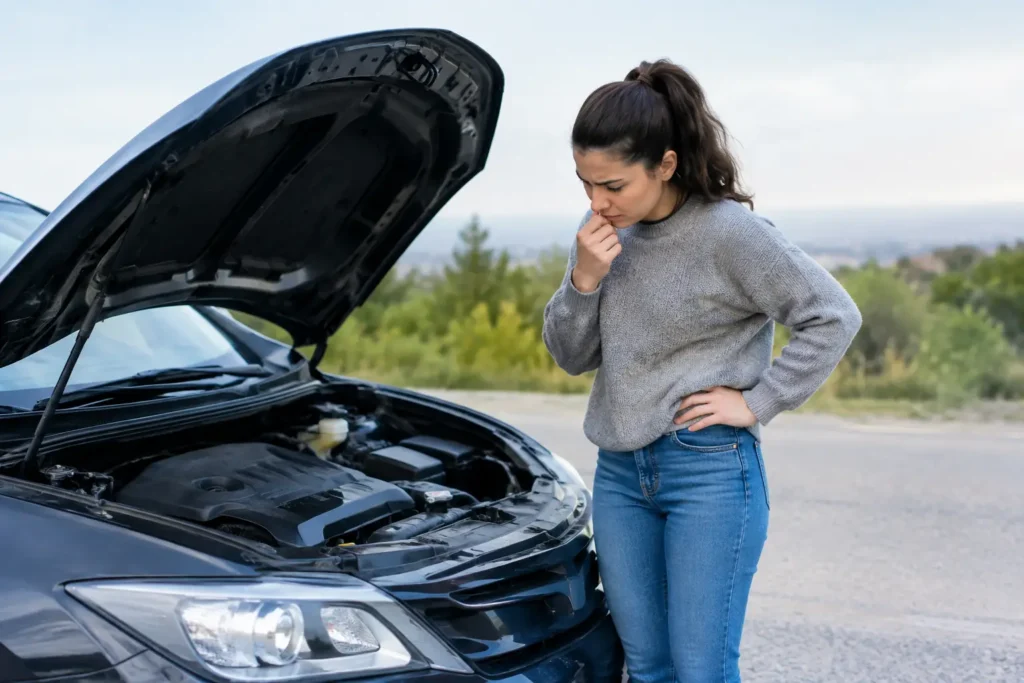
Your car stalls at a traffic light, in slow-moving traffic, or just as you pull away from a parking space. The engine suddenly goes quiet, the steering feels heavier, and one question comes quickly: why does my car stall? A stall can be caused by something as simple as a dirty throttle body or as serious as a fuel-delivery or electrical fault. The safest approach is not to guess, especially on Dubai roads where heat, traffic, and stop-start driving can expose a developing problem quickly.
What a Stalling Car Is Telling You
Stalling means the engine has stopped running when it should be able to maintain itself. It is different from a brief hesitation, a rough idle, or slow acceleration, although those symptoms often appear before the first stall.
For an engine to keep running, it needs the right amount of clean air, fuel, spark, and electrical control at the correct time. If one of those elements drops out, even for a moment, engine speed can fall below idle and the vehicle may shut off.
The timing of the stall matters. A car that dies only at idle points technicians toward a different set of possibilities than a car that stalls under acceleration, after getting hot, or while driving at speed. Note what happened before the engine stopped. That information can save time and prevent unnecessary parts replacement.
Why Your Car Stalls at Idle or When Stopping
Dirty throttle body or airflow problems
Modern engines use a throttle body to control incoming air. Over time, carbon deposits can build up around the throttle plate. The engine may then struggle to hold a steady idle, particularly when the air conditioning is on or when you come to a stop after driving.
A contaminated mass airflow sensor can cause a similar issue. This sensor helps the engine computer calculate how much fuel to inject. If its reading is inaccurate, the mixture may become too rich or too lean, causing rough running and stalling.
Vacuum leaks also matter. Cracked hoses, worn intake seals, and disconnected lines allow unmetered air into the engine. The result can be an uneven idle, a whistling sound, poor fuel economy, and occasional stalling. Heat can harden rubber components over time, so this is particularly worth checking in a hot climate.
Fuel supply issues
An engine cannot stay running without consistent fuel pressure. A weak fuel pump, blocked fuel filter, failing fuel-pressure regulator, or restricted fuel injector can all reduce the fuel available to the engine.
Fuel-related stalling often becomes more noticeable during acceleration, climbing, or long drives when the vehicle is under greater demand. In some cases, the car may restart after sitting for several minutes, which can point to a fuel pump that is failing once it warms up. That is not a fault to ignore, because a complete no-start situation may be next.
Poor-quality or contaminated fuel can also cause rough running and stalling. If the symptoms began immediately after refueling, tell the workshop where and when you filled up. That detail is useful during diagnosis.
Spark and ignition faults
Gasoline engines need a reliable spark to ignite the air-fuel mixture. Worn spark plugs, damaged ignition coils, faulty plug wires on older vehicles, and moisture in electrical connections can cause misfires that eventually lead to a stall.
A misfire is often felt as shaking, hesitation, or a flashing check engine light. If the check engine light is flashing, avoid continuing to drive unless necessary for immediate safety. Ongoing misfires can overheat and damage the catalytic converter, turning a manageable repair into a more expensive one.
German and American vehicles can both be sensitive to ignition faults, though the exact failure pattern varies by model and engine. Proper diagnostic scanning and testing are more reliable than replacing coils or plugs based on assumption.
Electrical Problems That Can Shut Down the Engine
Weak battery, alternator, or loose connections
Many drivers think the battery only matters when starting the car. In reality, the battery and charging system support the vehicle’s electronics while the engine is running. If the alternator is not charging properly, voltage can drop until control modules, ignition components, or fuel-system electronics can no longer operate correctly.
Warning signs include a battery light, dimming headlights, slow power windows, warning messages, or a stall followed by difficulty restarting. A corroded battery terminal or poor ground connection can create similar symptoms.
Do not assume a new battery has solved the problem. A workshop should test battery condition, charging voltage, alternator output, and voltage drop across key connections. Replacing parts without these checks can waste money.
Crankshaft and camshaft sensor faults
The engine computer relies on position sensors to know when to fire the spark plugs and inject fuel. A failing crankshaft position sensor can cause an engine to cut out abruptly, sometimes with no warning. The vehicle may restart immediately, restart only after cooling down, or refuse to start until the sensor begins working again.
Camshaft sensor faults may cause similar symptoms, often along with extended cranking, poor performance, or a check engine light. These faults need live data testing and fault-code interpretation. A stored code is a useful clue, not automatic proof that the named part is the only problem.
Other Reasons a Car May Stall
Automatic vehicles can stall when coming to a stop if there is a transmission or torque-converter issue. On a manual vehicle, an engine may stall because the clutch is released too quickly, but repeated stalling by an experienced driver can indicate clutch, idle-control, or engine-management trouble.
An overheating engine can also shut down or run poorly enough to stall. Watch the temperature gauge and never continue driving if the engine is overheating. Low coolant, a failed thermostat, a cooling fan fault, or a water pump problem should be inspected promptly.
On diesel vehicles, fuel contamination, air entering the fuel system, injector faults, or issues with emissions equipment may be involved. Diesel diagnosis requires a different process from gasoline-engine diagnosis, so the vehicle’s fuel type and service history should always be considered.
Clues That Help Identify Why Your Car Stalls
The most useful clue is when the stall happens. If it stalls only at red lights or while parking, airflow, idle control, vacuum leaks, or throttle-body deposits are more likely. If it loses power and dies during acceleration, fuel pressure, ignition, or sensor faults deserve attention.
If the vehicle stalls after a long drive or only once the engine is hot, heat-sensitive sensors, fuel pumps, coils, or electrical connections are possible. If it dies when the air conditioning turns on, the additional load may be exposing a weak idle system or charging problem.
Pay attention to dashboard warnings, unusual smells, rattling, clicking, smoke, fuel consumption, and whether the engine restarts easily. A short video of the dashboard warning lights or rough idle can also help a technician see the fault as it occurs.
What to Do When Your Car Stalls
First, stay calm and move the vehicle out of traffic if it is safe to do so. Turn on your hazard lights. Remember that power steering and brake assistance may reduce when the engine is off, so steering and braking can require more effort.
Try restarting only once you are safely stopped. If the engine starts and runs normally, drive only as far as necessary to reach a safe location or workshop. If it stalls again, the check engine light flashes, the temperature is high, you smell fuel, or there is smoke, stop driving and arrange recovery.
Avoid repeatedly cranking the engine for long periods. This can drain the battery and may make diagnosis harder. Also avoid clearing warning codes before inspection. Those codes and their freeze-frame data can show what the engine computer saw at the moment the fault occurred.
A proper assessment should include a diagnostic scan, visual inspection, battery and charging-system test, and targeted tests of fuel pressure, ignition, air intake, and sensors as needed. The right repair depends on evidence, not on the most common cause found online.
Get a Clear Diagnosis Before Approving Repairs
Stalling can be intermittent, which makes it frustrating for drivers and technicians alike. The goal is to reproduce the condition where possible, review the vehicle’s fault history, and test the systems connected to the symptom. A transparent workshop should explain what has been confirmed, what remains possible, and why a recommended repair is needed.
At HYATTS AUTO CARE, that means dealership-level diagnostic care without vague answers or unnecessary part replacement. If your car has stalled once, treat it as an early warning rather than waiting for it to leave you stranded. A clear inspection now can protect your safety, your time, and your repair budget.