

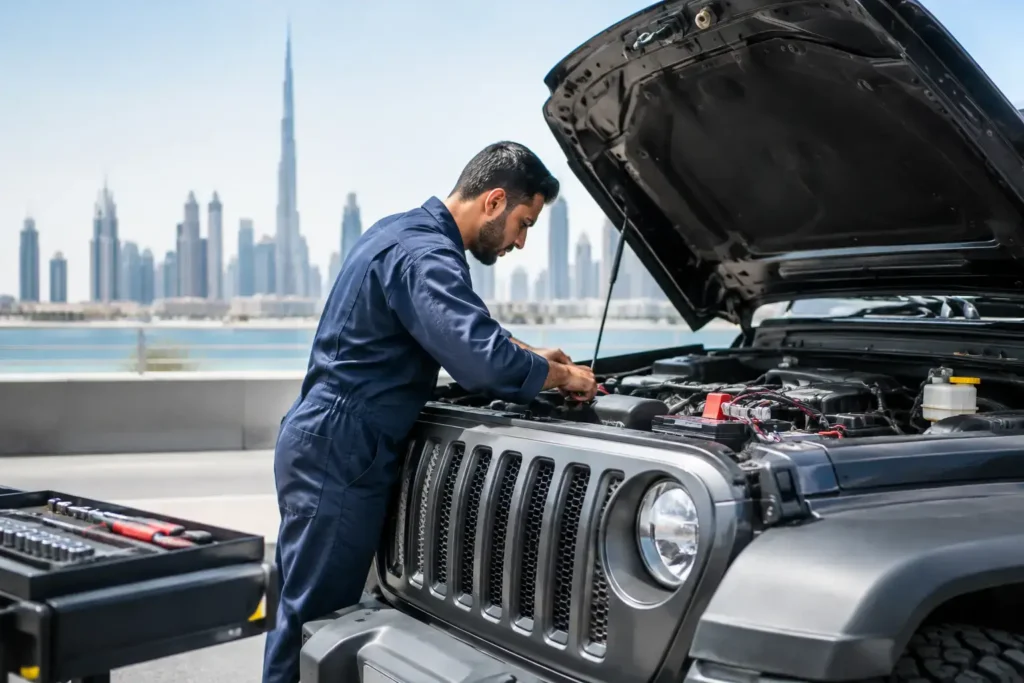
A Jeep that starts perfectly at home but refuses to start after a stop in Dubai traffic can quickly become more than an inconvenience. In this Jeep electrical repair case study, the warning signs pointed in several directions at once: an occasional no-start condition, flickering dash lights, and a battery that had already been replaced without solving the problem.
Electrical faults are frustrating because the symptom is often not the source. A weak connection can imitate a failed battery. A charging problem can look like a starter issue. A module may report a fault simply because it is not receiving stable voltage. The right repair begins with testing, not assumptions.
The Customer Concern: Intermittent Starting and Warning Lights
The Jeep arrived with a complaint many owners recognize: some days it started immediately, while on other days the engine would not crank or would crank slowly. The customer had also noticed intermittent warning lights and a brief loss of power to some interior electrical functions.
There was no single, permanent fault code that clearly identified one failed part. That matters. When a vehicle behaves normally in the workshop but fails unpredictably on the road, replacing parts based only on symptoms can become expensive very quickly.
The first goal was to confirm the condition of the battery, starter circuit, charging system, and main electrical grounds. These are the foundations of the vehicle’s electrical system. If voltage or ground quality is unstable, diagnostic results from other systems can be misleading.
Jeep Electrical Repair Case Study: Testing Before Replacing Parts
A visual inspection came first. The battery terminals were secure, but a close inspection found oxidation around one connection and signs that moisture and heat had affected part of the wiring near the battery area. In Dubai, high temperatures accelerate wear on batteries, insulation, connectors, and plastic electrical housings. Heat alone does not always cause a fault, but it can expose a connection that was already marginal.
The battery was tested under load rather than judged by its age or voltage reading alone. It passed the initial test. The alternator output was also within an acceptable range during a basic charging test. At this stage, replacing either component would not have been justified.
Next came voltage-drop testing. This test measures how much voltage is lost as current travels through cables, terminals, and ground connections while the system is under load. A cable may look fine from the outside while corrosion inside the terminal or wire creates resistance. That resistance can prevent the starter from receiving the current it needs, especially when the engine bay is hot.
Testing revealed excessive voltage drop on the ground side of the starting circuit. The main ground connection had corrosion where it met the chassis. It was not completely disconnected, which explained why the Jeep could start normally much of the time. But under certain conditions, the compromised connection was creating enough resistance to cause slow cranking, warning lights, and inconsistent electrical behavior.
Why the Scan Tool Was Only Part of the Diagnosis
Modern Jeeps use multiple control modules that communicate across the vehicle network. When supply voltage drops unexpectedly, modules can store communication codes or low-voltage faults. Those codes are useful clues, but they are not always a diagnosis by themselves.
In this case, the scan results showed several historic low-voltage-related entries across different systems. Replacing every component connected to those entries would have been unnecessary. The pattern pointed back to one shared issue: unstable electrical supply.
This is why a proper electrical inspection combines scan-tool data with hands-on testing. A code tells the technician what the vehicle noticed. Voltage readings, load tests, wiring checks, and connector inspections help identify why it happened.
The Repair: Restoring a Reliable Ground Path
The affected ground point was removed, cleaned, and inspected for damage. The mounting surface was prepared to ensure solid metal-to-metal contact, and the connection was resecured correctly. The related cable and terminal condition were also checked to make sure the repair addressed more than the visible corrosion.
The battery terminals were cleaned and protected, and the charging system was retested. After the ground repair, voltage-drop readings returned to normal. The Jeep was then started repeatedly, tested with electrical loads switched on, and monitored for charging stability.
The intermittent warning-light behavior did not return during testing. Stored low-voltage faults were cleared, followed by a final scan to confirm that no immediate issues came back. The result was a reliable start circuit without replacing a starter motor, alternator, or additional control modules that had not failed.
For the owner, the important outcome was not simply that the Jeep started that day. It was knowing the workshop had identified the reason behind the fault and avoided a list of speculative repairs.
What This Case Shows Jeep Owners
Electrical problems do not always need major parts, but they do need a methodical process. A Jeep with a no-start condition could have a worn starter, weak battery, charging fault, damaged wiring, corroded grounds, ignition-switch issue, or a module-related problem. The correct answer depends on test results.
It also depends on the timing of the fault. If a Jeep only has trouble after sitting overnight, the technician may check for battery drain. If it fails after driving in heavy heat, heat-related resistance or a weak starter may be more likely. If warning lights appear after rain, moisture intrusion at a connector or fuse box deserves closer attention.
The trade-off is simple: fast part replacement can sometimes fix a problem by chance, but it can also add cost without fixing the root cause. Careful diagnosis takes more time at the beginning, yet it often prevents repeated visits and unnecessary expense later.
Signs You Should Book an Electrical Inspection
An occasional slow crank, dimming headlights, repeated battery problems, random warning lights, non-working accessories, or a burning electrical smell should not be ignored. These symptoms can worsen without warning, particularly during hot weather when the battery and charging system are working harder.
If the vehicle still starts, that is the best time to have it checked. Waiting until it will not start at all can turn a planned workshop visit into a roadside recovery situation.
At HYATTS AUTO CARE, electrical repair starts with clear testing and straightforward communication. If a part is needed, the reason is explained. If a repair can be completed without replacing a major component, that is explained too. Quality service, honest pricing, and fast turnaround begin with finding the actual fault.
A reliable Jeep should not leave you guessing whether it will start after your next stop. When electrical symptoms appear, a focused inspection can provide a clear answer before a small connection issue becomes a bigger disruption.