

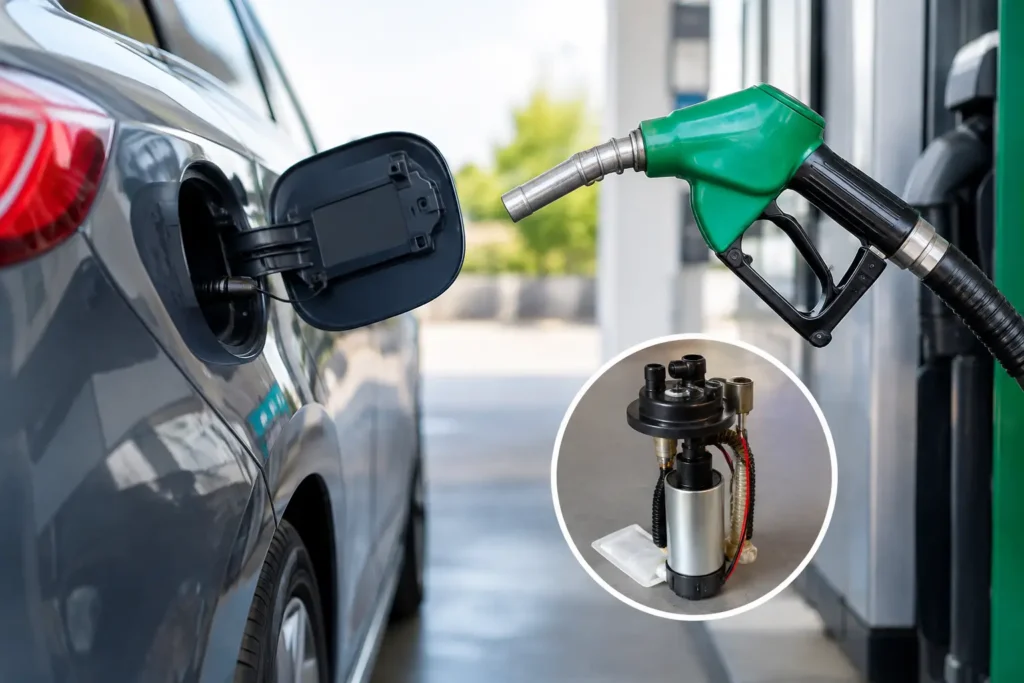
A car that cranks normally but will not start can turn an ordinary Dubai commute into a frustrating delay. Fuel pump symptoms are easy to mistake for battery, ignition, sensor, or engine problems, which is why replacing parts based on a guess often wastes time and money. The fuel system needs proper testing before anyone can say the pump is at fault.
What the Fuel Pump Does
The fuel pump moves fuel from the tank to the engine at the pressure and volume required for combustion. On most modern vehicles, an electric pump sits inside the fuel tank and works with a fuel filter, pressure regulator, injectors, wiring, relays, and control modules.
When the pump weakens, it may still work under light load but struggle when the engine needs more fuel. That is why a vehicle can feel acceptable around town, then hesitate during hard acceleration, highway driving, or when climbing a ramp. A complete pump failure, on the other hand, can leave the engine cranking with no start at all.
Heat matters in Dubai. High ambient temperatures place extra demand on electrical components and can expose a pump that is already worn, especially when the vehicle is frequently driven with a near-empty tank.
Fuel Pump Symptoms That Need Attention
A failing pump rarely gives every warning sign at once. The pattern, the conditions under which it happens, and the vehicle’s fault codes all matter.
Extended cranking or a no-start condition
One common sign is an engine that takes longer than usual to start. You may turn the key or press the start button and hear the engine cranking for several seconds before it fires. In some cases, it starts after sitting for a while but refuses to restart when hot.
If the pump has stopped operating completely, the engine may crank strongly but never start. This differs from a weak battery, where cranking itself is slow or the dashboard lights fade. Still, a no-start does not automatically mean the pump has failed. A blown fuse, failed relay, damaged wiring, immobilizer issue, crankshaft sensor fault, or lack of injector command can create a similar result.
Hesitation, surging, or loss of power
A vehicle that hesitates when you accelerate may not be receiving consistent fuel pressure. The engine can feel flat, stumble before overtaking, or lose power at higher speeds. Some drivers describe it as if the car briefly stops responding to the accelerator.
Surging can happen too. Instead of delivering fuel smoothly, a weak pump may supply inconsistent pressure, causing the engine speed to rise and fall without a matching change in pedal input. These symptoms deserve prompt attention because they can make merging and passing less predictable.
Stalling when the engine is under load
A marginal pump may keep the engine running at idle but fail when demand increases. The vehicle may stall in traffic, during acceleration, with the air conditioning running, or after a longer drive. It may restart immediately, restart only after cooling down, or need several attempts.
That pattern is useful diagnostic information. Note whether the stalling occurs with a low fuel level, in hot conditions, after a fuel stop, or only when the engine is fully warm. Clear details help a technician test the right system rather than chase an intermittent fault blindly.
Whining or buzzing from the fuel tank area
Electric fuel pumps usually produce a brief hum when the ignition is switched on. A louder-than-normal whine, droning noise, or irregular buzzing from the rear of the vehicle can indicate that the pump is working too hard.
Noise alone is not a diagnosis. Some vehicles have naturally audible pumps, and sound can travel through the body of the car. But a new noise combined with difficult starts, power loss, or stalling should be inspected before the vehicle becomes unreliable.
Reduced fuel economy and a check engine light
Poor fuel delivery can affect combustion and trigger warning lights, though fuel economy problems are not exclusive to the pump. A check engine light may appear with lean-condition codes, fuel pressure faults, or misfire codes. Those codes point a technician toward an area of concern, but they do not prove which component needs replacement.
Modern German and American vehicles can also limit performance when engine management detects a fuel-pressure problem. You may see a reduced-power message, experience weak acceleration, or notice that the car will not rev as freely as normal.
Why a Fuel Pump Fails
Fuel pumps wear out over time, but age is only one part of the picture. Running consistently low on fuel is a common contributor because the fuel in the tank helps cool and lubricate an in-tank electric pump. It does not mean one low-fuel trip will destroy the pump, but making it a habit can shorten component life.
Contaminated fuel, rust or debris in the tank, a blocked filter, and electrical resistance can also cause trouble. A weak connection, corroded ground, damaged wiring, or failing relay may prevent a good pump from receiving proper voltage. Replacing the pump without checking its electrical supply can leave the original problem unresolved.
On certain vehicles, the fuel system includes a control module, transfer pump, fuel pressure sensor, or high-pressure pump in addition to the in-tank low-pressure pump. The repair approach depends on the actual system design. This is one reason a quick diagnosis based only on a symptom can become expensive.
How a Proper Fuel System Diagnosis Works
A reliable diagnosis begins by confirming the complaint. The technician checks whether the engine is cranking, whether it has spark and injector operation, and whether the issue is constant or intermittent. A scan tool is used to read fault codes and live data, including requested and actual fuel pressure where the vehicle provides it.
Next, the electrical side must be checked. This can include testing fuses, relays, voltage supply, ground quality, and wiring at the pump connector. A pump may sound active yet fail to produce enough pressure or fuel volume. Conversely, a pump that does not run may be healthy but missing power because of a relay, control module, or wiring issue.
Fuel pressure and delivery testing provide the evidence needed before replacement. The exact method depends on the vehicle, since many late-model systems require manufacturer-level scan data and safe, model-specific test procedures. Fuel is flammable, and high-pressure fuel systems require particular care. This is not a repair to attempt with improvised tools in a parking area.
At HYATTS AUTO CARE, the goal is to identify whether the fault is the pump itself, the electrical circuit, a restriction, or another engine-management issue before recommending repairs. That approach supports honest pricing and avoids replacing a part simply because it is a common suspect.
Can You Keep Driving With Suspected Fuel Pump Problems?
It depends on the symptom. If the car has only a mild new noise and drives normally, arrange an inspection soon and avoid unnecessary long trips until the cause is known. Keep more than a quarter tank of fuel where possible, particularly if the issue seems worse at low fuel levels.
If the engine is stalling, losing power in traffic, struggling to start, or showing a fuel-pressure warning, do not treat it as a routine inconvenience. A sudden loss of power can create a safety risk, and repeated starting attempts can drain the battery or complicate diagnosis. Arrange recovery if the vehicle is not dependable enough to drive safely.
Avoid adding fuel-system cleaners as a cure for a failing pump. A quality cleaner may help with certain deposit-related issues, but it cannot repair worn pump internals, damaged wiring, or a failing control module. It can also delay a proper inspection when the real issue needs attention.
What to Tell Your Repair Shop
Before booking in, make a note of when the symptoms occur. Mention whether the car starts after sitting, whether it stalls when hot, how much fuel is in the tank, whether warning lights appeared, and whether the problem follows a fuel fill-up. If you hear an unusual noise from the rear of the vehicle, explain when it happens.
Those details can reduce diagnostic time and help separate fuel pump symptoms from problems with the battery, ignition system, air intake, sensors, or transmission. A dependable repair starts with accurate information, clear testing, and a repair recommendation you can understand before work begins.
If your car is warning you with difficult starts, hesitation, or stalling, act while it is still able to tell you what is wrong. Early testing is usually far less disruptive than being stranded when the pump finally stops working.