

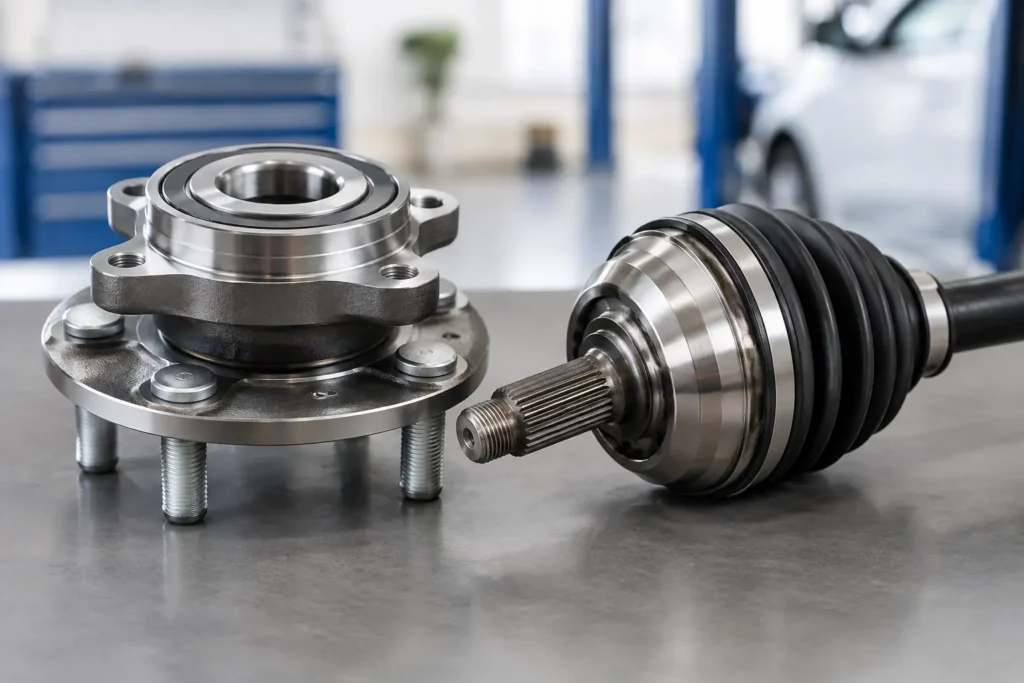
A new noise from the front of your car can be frustrating, especially when it appears only on turns, at highway speed, or under acceleration. In the wheel bearing versus CV joint question, the symptoms can seem similar at first: both are close to the wheels, both can create noise, and both deserve prompt attention. The difference matters because the correct repair depends on identifying the failed component, not replacing parts based on a guess.
For drivers in Dubai, where daily highway travel, heat, and stop-start traffic can expose weak mechanical parts quickly, a clear diagnosis can prevent a small issue from becoming a breakdown or a more expensive repair.
Wheel Bearing Versus CV Joint: What Each Part Does
A wheel bearing is a set of hardened steel balls or rollers that allows the wheel hub to rotate smoothly. It carries the vehicle’s weight while dealing with braking forces, cornering loads, road impacts, and heat. Modern vehicles may use a sealed bearing pressed into the steering knuckle or a complete hub-and-bearing assembly.
A CV joint, short for constant velocity joint, is part of the driveshaft or axle. Its job is to transfer engine power to the wheels while allowing the suspension to move and the front wheels to steer. Front-wheel-drive vehicles have CV joints on both ends of each front axle. Many all-wheel-drive and rear-wheel-drive vehicles use them as well.
Put simply, a bearing helps the wheel spin. A CV joint helps deliver power to that spinning wheel. They work near each other, but their noises usually occur under different conditions.
The Sounds That Point to a Wheel Bearing
The classic wheel-bearing symptom is a steady humming, droning, growling, or rumbling noise that increases with road speed. It may begin quietly around 30 to 40 mph and become far more noticeable at highway speeds. Unlike engine noise, it does not necessarily rise and fall with RPM. If you shift to a lower gear and the sound stays tied to vehicle speed, a wheel bearing becomes more likely.
The sound can change while gently turning. When a vehicle turns left, more load is placed on the right-side wheels. When it turns right, the left side is loaded more heavily. A worn bearing often becomes louder when its side is loaded, although sound can travel through the suspension and body, making the noisy side difficult to identify from the driver’s seat.
Other possible signs include a vibration through the steering wheel, uneven tire wear caused by excessive play, or a loose-feeling wheel. In severe cases, a damaged bearing can create noticeable movement when the wheel is lifted and checked correctly. That is not a condition to ignore. A bearing that deteriorates badly can affect wheel stability, braking performance, and ABS sensor operation.
Tire noise can imitate a bad bearing. Cupped tires, uneven tread wear, aggressive tire patterns, and poor alignment can all create a similar hum. This is why a proper road test and inspection matter more than diagnosing the issue by sound alone.
The Sounds That Point to a CV Joint
An outer CV joint commonly makes a repeating clicking or snapping sound while turning at low speed, especially with steering close to full lock. You may hear it when pulling out of a parking space, making a U-turn, or entering a roundabout. The clicking generally becomes faster as the wheel rotates.
An inner CV joint often behaves differently. Instead of clicking on tight turns, it may cause a shudder, vibration, or knocking sensation during hard acceleration. Some drivers feel this through the floor or seat rather than hearing a clear noise. If the vibration reduces when you lift off the accelerator, the inner CV joint or axle should be inspected.
CV joints are protected by flexible rubber boots filled with grease. A split boot can throw grease around the inside of the wheel, suspension, or underbody. Catching a torn boot early may allow a technician to clean and reboot the joint if it has not run dry or collected dirt. Once a joint is noisy, however, replacing the complete axle assembly is often the more dependable repair.
A damaged CV joint can also create vibration, but it usually relates more closely to acceleration, steering angle, or load than a wheel bearing does. That distinction gives a technician useful direction during a road test.
Why Symptoms Can Overlap
Not every fault follows the textbook. A worn wheel bearing can make a grinding sound at lower speed, while a severely worn CV joint can clunk when the vehicle changes from acceleration to deceleration. Loose suspension components, brake issues, differential problems, and damaged tires can add more noise to the picture.
Vehicle layout also matters. On a German performance vehicle with all-wheel drive, there may be several driveshafts, joints, bearings, and electronically monitored systems involved. On an American SUV or pickup, axle, hub, and suspension designs vary substantially by model. Replacing a part before confirming the source can waste money and leave the original problem unresolved.
That is why a good inspection normally includes a road test, tire check, wheel play check, examination of CV boots and grease leaks, and inspection of the axle, brakes, and suspension. If needed, a technician can listen for bearing roughness with the vehicle safely raised and use diagnostic equipment to check related warning lights or sensor faults.
What the Repair Usually Involves
Wheel-bearing repairs vary by vehicle. Some models require the bearing to be pressed out of the steering knuckle and a new one installed with the correct tools and procedures. Others use a bolt-on hub assembly. The labor time, parts cost, and need for wheel alignment depend on the design and whether corrosion or seized components complicate removal.
CV-joint repairs also depend on the condition of the joint and boot. A fresh boot may be appropriate when caught very early, but a clicking joint normally needs more than grease. In many cases, replacing the axle assembly is the practical choice because it renews the worn joint and comes with a new boot. Quality matters here. Poor-quality axles can introduce vibration, fitment issues, or a short service life.
Do not assume both sides must be replaced just because one bearing or axle has failed. These components do not always wear evenly. The right approach is to inspect both sides and replace only what is worn, unless there is a clear reason to do more work at the same time. That is the kind of decision that should be explained clearly before repairs begin.
When You Should Stop Driving
A light bearing hum or occasional CV click should be booked for inspection soon, rather than left for the next routine service. If the sound becomes loud quickly, the vehicle pulls unexpectedly, there is a strong vibration, grease is visibly sprayed around a wheel, or an ABS or traction-control warning appears, avoid long or high-speed trips until it has been checked.
If you feel a wheel wobble, hear grinding that is getting worse, or suspect a wheel is loose, stop driving and arrange recovery. A damaged wheel bearing can become a safety issue, while a failed CV joint can leave the vehicle unable to drive.
At HYATTS AUTO CARE, the goal is not to sell a bearing or axle before the fault is confirmed. A careful inspection helps separate tire noise, bearing wear, CV-joint damage, and other suspension or drivetrain concerns, so you understand what needs attention and why.
The most useful detail you can give your technician is when the noise happens: while turning, accelerating, cruising, braking, or at a certain speed. That one observation can make the diagnosis faster, the estimate clearer, and your next drive much less uncertain.