

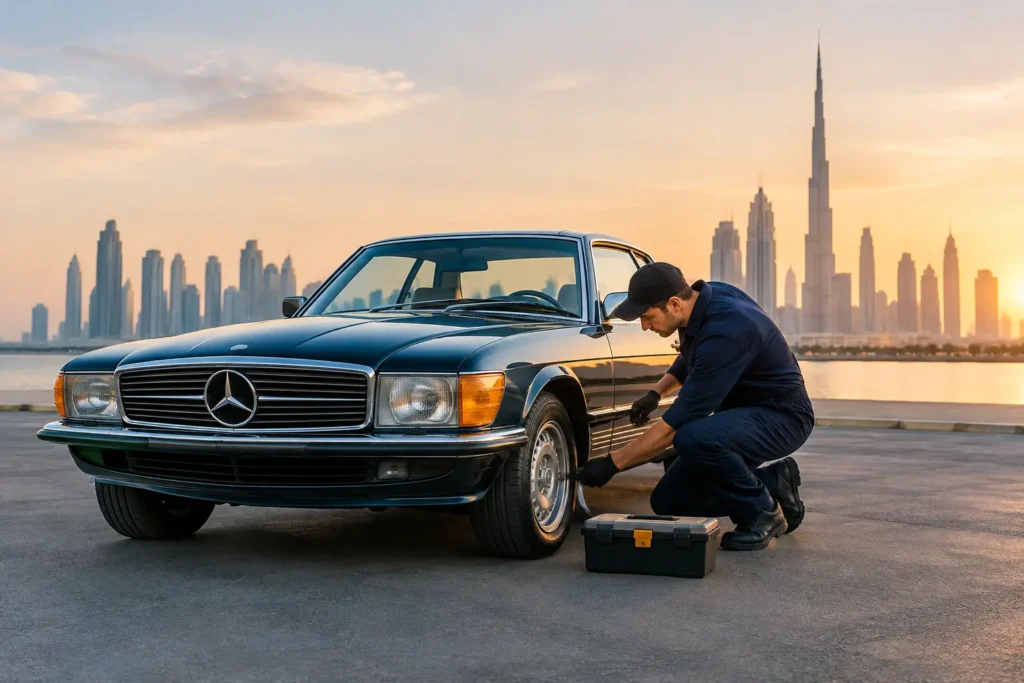
A Mercedes restoration case rarely begins with a car that simply needs a coat of paint. More often, it starts with a Mercedes that still drives, but has lost the condition its owner remembers: faded panels, tired leather, warning lights, oil leaks, loose steering, or repairs from the past that were never finished properly. In Dubai, heat, dust, traffic, and years of sun exposure can make those problems appear faster than expected.
A proper restoration is not about making a vehicle look good for handover day. It is about deciding what deserves repair, what can be preserved, and what needs to be addressed first so the finished car is safe, dependable, and worth owning long after it leaves the workshop.
The vehicle: a usable Mercedes with hidden problems
Consider a representative case: an older Mercedes sedan or coupe that has been in the same family for years. The body is straight enough to save, but the clear coat has failed on the roof and hood. The bumper has parking damage, the headlights are dull, and the cabin shows cracked trim and worn switchgear. The owner also reports an intermittent battery warning and steering that feels heavier than it should at low speeds.
It would be easy to focus on the visible damage. That is also how restoration budgets go wrong. Cosmetic work completed before mechanical and electrical faults are understood can lead to rework, delays, and frustration. A paint-ready front end may need to come apart again for a cooling leak, a wiring repair, or access to a worn component.
The sensible starting point is a full condition check. This establishes whether the project should be a targeted facelift, a staged restoration, or a deeper rebuild. The right answer depends on the model, its condition, the owner’s budget, and how the car will be used.
Inspection comes before promises
A restoration plan should be based on evidence, not assumptions. On a Mercedes, the workshop needs to inspect body condition, scan fault codes, assess major mechanical systems, and check whether prior repair work meets a safe standard.
Rust may not be the first concern in Dubai, but imported vehicles and cars with accident history can have corrosion in hidden areas. Panel gaps, paint texture, overspray, and uneven tire wear can reveal older collision repairs or poor alignment. Under the hood, fluid leaks, brittle hoses, aging engine mounts, and neglected service items often appear once covers are removed.
Electrical diagnosis matters just as much. Modern Mercedes vehicles rely on connected control modules, sensors, wiring, and battery management systems. An illuminated warning light is not a diagnosis. A proper scan provides a starting point, but the cause may be a weak battery, damaged wiring, a failed sensor, a grounding issue, or a component that needs refurbishment.
At HYATTS AUTO CARE, the goal is to explain those findings in straightforward terms before work begins. Customers should know what is urgent, what can wait, what the expected cost is, and why a repair is recommended. That is especially important on restoration work, where opening up one area can reveal additional issues.
Building the right scope for the Mercedes restoration case
Once the inspection is complete, the work should be organized in a practical order. Safety and reliability come first, followed by body repair and refinishing, then the final cosmetic details. This sequence protects the investment in paintwork and avoids treating a restoration like a collection of unrelated jobs.
For the representative Mercedes, the first phase may include resolving the electrical charging concern, servicing the engine and transmission as needed, repairing leaks, checking brakes and suspension, and assessing the steering system. If the electric power steering unit is faulty, refurbishment may be a better-value solution than immediately replacing it with a costly new unit. That depends on the specific fault and whether the underlying components are serviceable.
The second phase addresses the exterior. Dents need to be repaired correctly rather than filled excessively. Damaged bumper mounts, clips, trims, and seals should be identified before paint preparation begins. Panels must be properly prepared and refinished so color, gloss, and texture look consistent in natural light, not only under workshop lighting.
Finally, attention turns to details that change how the car feels every day. Headlight restoration, wheel refinishing, interior trim repair, replacement badges, cleaned engine-bay plastics, and careful panel alignment can make an older Mercedes feel complete without spending money on unnecessary modifications.
Original condition or a refreshed look?
Not every Mercedes should be restored to factory-original specification. A well-kept W124, W126, R129, or early AMG may benefit from preserving correct materials, finishes, and period details. Originality can affect long-term desirability, particularly for rare or collector-focused cars.
A daily-driven Mercedes has different needs. The owner may prefer updated lighting, refreshed wheels, modern infotainment, or a cleaner color scheme that suits the car’s current role. Neither approach is automatically better. The important thing is to agree on the destination before ordering parts or starting paintwork.
This is where honest discussion saves money. A full restoration can exceed the market value of some older models, even when the car has personal value. A focused facelift may deliver most of the satisfaction at a more manageable cost. For others, a complete restoration is worthwhile because the vehicle is rare, sentimental, or exceptionally sound underneath.
Why paintwork needs more than a good color match
Dubai’s sun is unforgiving. A panel can match perfectly when it leaves the paint booth but look different next to weathered paint on the adjacent panel. For this reason, a quality repair often involves blending surrounding panels rather than painting only the visibly damaged area.
Preparation makes the difference. The surface must be cleaned, repaired, primed, blocked, and prepared before color is applied. Rushing this stage can leave sanding marks, uneven texture, poor adhesion, or visible repairs later. The same principle applies to plastic bumpers, where proper repair materials and preparation are needed to prevent cracking or peeling.
The owner should also be realistic about what paint can and cannot fix. Deep corrosion, previous poor repairs, missing trim, and distorted panels require more than polishing. Conversely, a car with healthy paint but light oxidation may only need correction and protection, not a full repaint. A good workshop recommends the level of work the vehicle actually needs.
Parts, timing, and budget control
Mercedes restoration projects can slow down when the wrong parts are ordered or when discontinued items need sourcing. Genuine parts may be the preferred choice for critical components and factory fitment, while quality aftermarket alternatives can make sense for certain wear items. Used parts can be suitable for hard-to-find interior trim or non-safety cosmetic pieces, provided their condition is checked carefully.
There is always a trade-off between cost, availability, and originality. The cheapest option is not always economical if it fails early or fits poorly. At the same time, every component does not need the most expensive replacement available. Clear options let the owner make an informed decision.
A staged estimate is useful for controlling spend. The first estimate covers confirmed work from the inspection. If dismantling reveals additional damage, the workshop should contact the customer with photos, an explanation, and revised options before proceeding. That approach keeps the project moving without leaving the owner uncertain about the final bill.
The final check is where trust is earned
Before handover, the car should be road-tested and checked for warning lights, fluid leaks, steering response, brake performance, electrical functions, and panel fit. Paint should be inspected in daylight, and the interior should be reassembled with care. A restoration is not complete because the vehicle starts. It is complete when the details work together.
For a Mercedes owner, the best result is not just a cleaner exterior or a quieter cabin. It is the confidence of getting into the car, turning the key or pressing the start button, and knowing the work beneath the surface received the same attention as the finish you can see.
If your Mercedes is showing its age, start with an inspection and a clear conversation about your priorities. A careful plan can turn a car you have been putting off repairing into one you are proud to drive again.