

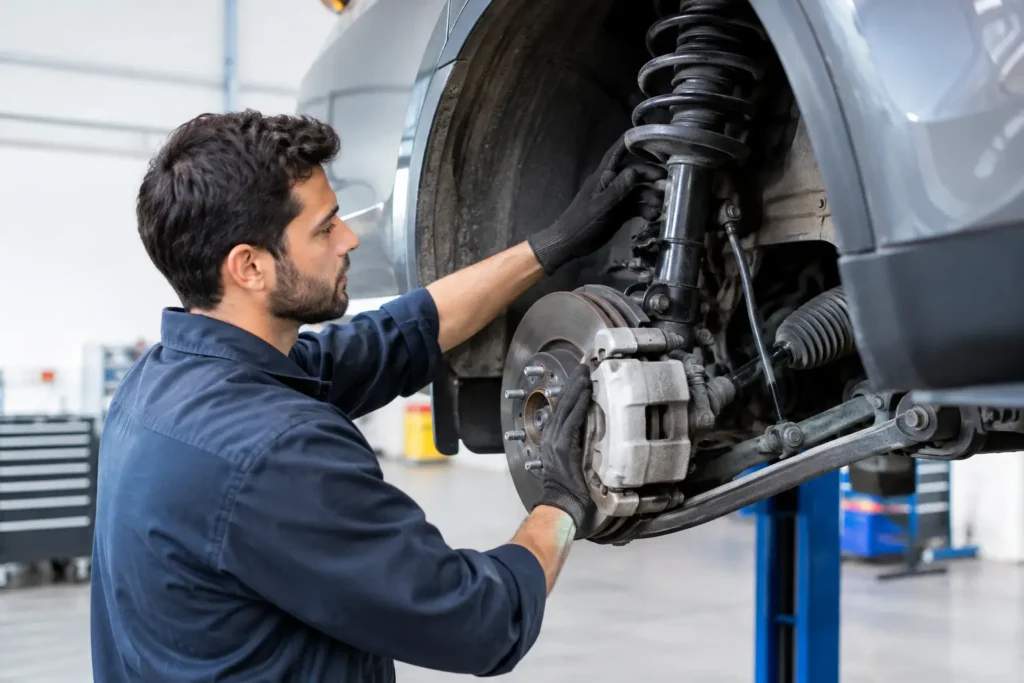
A hard knock over a speed bump, a steering wheel that pulls on Sheikh Zayed Road, or a car that feels unsettled through a bend can turn an ordinary drive into a concern. This vehicle suspension repair guide Dubai drivers can use explains what those changes may mean, what can wait, and when a proper workshop inspection is the sensible next step.
Dubai roads are generally well maintained, but daily heat, construction-area surfaces, speed humps, parking curbs, and long highway miles all place demand on suspension components. The issue is not always a major repair, but ignoring early symptoms often turns a contained job into additional tire, steering, or safety-related expense.
What Your Suspension Actually Does
Your suspension is more than the part that makes the ride comfortable. It keeps the tires in consistent contact with the road, supports stable braking, controls body movement, and helps the vehicle track predictably through turns. Shocks or struts, springs, control arms, bushings, ball joints, stabilizer links, and wheel bearings all work together.
When one component wears out, the rest of the system can be affected. A weak shock absorber, for example, can allow extra wheel movement. That movement may cause uneven tire wear and put greater strain on mounts, bushings, and other parts. On German and American vehicles especially, suspension systems can be finely tuned, so fitting the right part and checking the alignment afterward matters.
Vehicle Suspension Repair Guide Dubai: Warning Signs
Suspension problems do not always announce themselves with a dramatic failure. Most begin with a change in feel, sound, or tire wear. Paying attention early helps you book repair on your terms instead of dealing with a breakdown or damaged tire later.
Knocking, clunking, or squeaking over bumps
A repeated clunk when crossing speed humps or rough patches can point to worn stabilizer links, control arm bushings, ball joints, shock mounts, or loose hardware. A squeak may come from dry or deteriorated rubber bushings. Sound alone does not confirm the failed part, which is why a physical inspection is better than replacing components based on a guess.
Bouncing or a floating ride
If the vehicle continues to bounce after a bump, dives noticeably under braking, or feels as if it floats at highway speed, worn shocks or struts are possible. This is not only a comfort issue. Reduced damping can affect stability and increase braking distance in certain conditions.
Pulling, wandering, or an off-center steering wheel
A car that drifts left or right may need wheel alignment, but alignment is not always the root cause. Worn control arm bushes, damaged suspension parts, incorrect tire pressures, or a bent wheel can produce similar symptoms. An alignment performed before the underlying fault is repaired may not hold for long.
Uneven tire wear
Check the inside and outside edges of your tires. Feathering, cupping, or rapid wear on one edge can indicate alignment concerns, weak dampers, or worn suspension joints. Tires are expensive, and they are often the first visible evidence that a suspension issue has been developing.
Fluid leaks or visible sagging
Oil around a shock absorber body can signal a failed seal. A vehicle sitting lower at one corner may have a weak or broken spring, a damaged air-suspension component, or another support issue. Do not ignore a sudden change in ride height, particularly if the tire is close to the wheel arch.
Why Dubai Conditions Change the Repair Conversation
Heat is hard on rubber. Over time, bushings, mounts, boots, and seals can crack, stiffen, or lose their ability to isolate movement. Fine dust can also work its way into damaged protective boots around ball joints and tie rods, accelerating wear once grease is lost.
There is also the practical reality of city driving. A suspension that seems acceptable on a smooth highway may knock sharply over Al Quoz access roads, speed humps, or parking ramps. If you regularly carry passengers, equipment, or family luggage, the extra load can make tired springs and dampers more noticeable.
Air suspension deserves particular care. It can deliver an excellent ride, but diagnosis should be methodical because the fault may involve an air spring, compressor, valve block, level sensor, wiring, or control module. Replacing the most obvious part without checking the system can waste money.
Diagnosis Before Parts: The Fair Way to Repair
Suspension repair should start with an inspection and a road test where appropriate. A technician needs to check for play in joints, leaking dampers, damaged boots, worn bushings, broken springs, loose fasteners, and abnormal tire wear. The vehicle may also need a scan for fault codes if it has electronically controlled or air suspension.
This approach protects you from vague diagnoses and unnecessary replacement. For example, a knocking noise may be a relatively inexpensive stabilizer link, not a full set of control arms. On the other hand, replacing only one visibly worn item can be false economy if related parts have significant play or if a pair of shocks has reached the end of its service life.
A trustworthy workshop should explain what has failed, what is worn but still serviceable, and what can reasonably be scheduled later. Ask to see the affected parts where possible. Clear communication matters as much as technical skill when the repair estimate includes several components.
Repair or Replace? It Depends on the Component
Some suspension parts are normally replaced rather than repaired. Ball joints, bushings, links, wheel bearings, and shock absorbers are wear items. In many vehicles, the ball joint or bushing is integrated into a control arm, so replacing the complete arm can provide a more dependable result than fitting a single aftermarket insert.
Shocks and struts are generally best replaced in axle pairs. Replacing only one may leave the vehicle uneven in damping response, especially during braking and cornering. Springs should also be assessed as a pair when one is broken or badly sagged, though the exact recommendation depends on vehicle age, condition, and part availability.
There are trade-offs with parts selection. Genuine parts may offer the closest original fit and ride characteristics, while high-quality aftermarket parts can be a sensible option when sourced correctly. The cheapest available component is rarely the best value if it leads to early noise, poor fitment, or repeat labor. Your workshop should be able to explain the options without pressuring you into a choice.
Do Not Skip Alignment After Suspension Work
Any repair involving control arms, tie rods, struts, springs, or other geometry-related components may require wheel alignment. Alignment sets the wheel angles so the car drives straight, steers correctly, and uses its tires evenly.
However, alignment is not a cure for worn suspension. The worn component must be repaired first. Once the repair is completed, a proper alignment check confirms that the vehicle is within specification and gives the new parts the best chance of lasting.
Can You Keep Driving?
If there is a light noise but the car remains stable, driving gently to a workshop may be reasonable. Avoid assuming that every sound is harmless, though. Stop driving and arrange prompt assistance if the steering feels loose, the vehicle pulls heavily, a wheel appears misaligned, there is severe grinding, ride height has dropped suddenly, or a warning message appears with noticeably poor handling.
Do not try to inspect suspension parts under a car supported only by a jack. Suspension components are under load, and safe diagnosis requires correct lifting equipment and experience.
Getting the Right Repair in Dubai
When booking an inspection, describe the symptom clearly: when it happens, which side it seems to come from, whether it occurs during braking or turning, and whether you recently hit a pothole or curb. That information can shorten diagnosis time.
At HYATTS AUTO CARE, the focus is on checking the complete cause of the concern, explaining the repair options clearly, and keeping you informed before work moves ahead. For German, American, and other makes, accurate diagnosis and quality parts fitment are how suspension repairs stay dependable without dealership-level pricing.
A suspension concern rarely improves by being ignored. If your car no longer feels planted, quiet, and predictable, book an inspection before worn parts start taking their toll on tires, steering, and your confidence behind the wheel.