

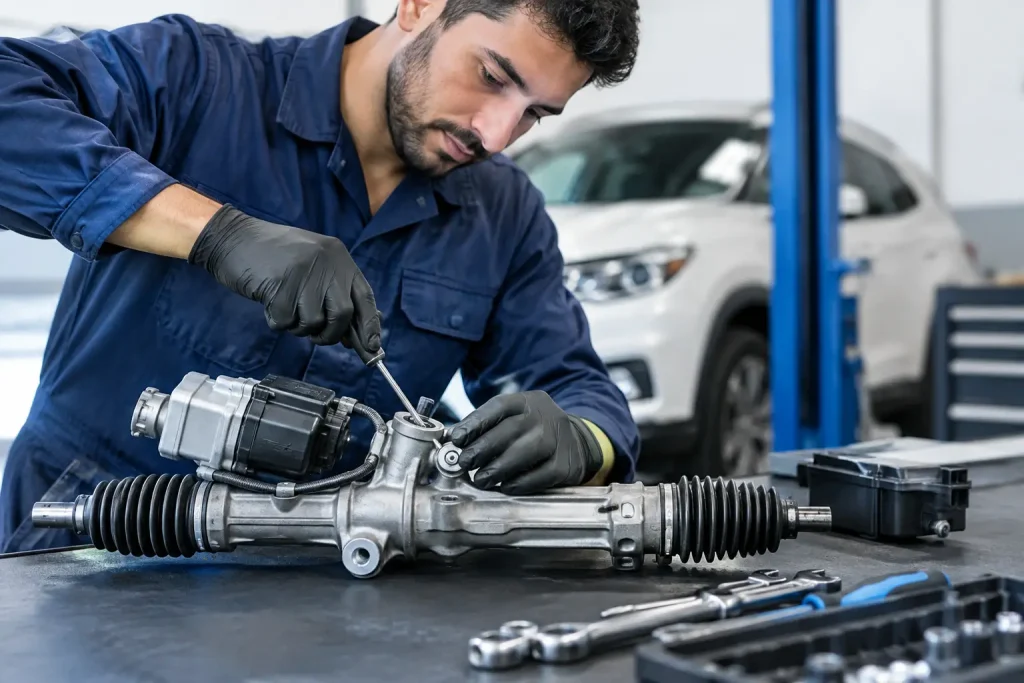
A steering wheel that suddenly feels heavy at a traffic light is not a problem to put off until next service. In Dubai heat, stop-start traffic, and long daily commutes, an electric power steering fault can quickly change from an occasional warning light to a vehicle that is difficult to control. Professional electric power steering repair Dubai drivers can rely on starts with finding the real cause, not simply replacing the most expensive part.
Electric power steering, often called EPS, uses an electric motor, sensors, wiring, and a control module to provide steering assistance. It is efficient and responsive, but it also means a steering issue may be mechanical, electrical, or software-related. The right repair depends on accurate diagnostics.
Signs Your Electric Power Steering Needs Attention
The most obvious sign is a steering wheel that feels unusually heavy, especially while parking or making low-speed turns. Some vehicles lose assistance only at first, so the steering may feel normal on the highway but difficult in a parking garage or when making a U-turn.
You may also see an EPS, power steering, or steering wheel warning light on the dashboard. Do not assume the warning is minor just because the vehicle still drives. The system may have stored a fault code, reduced assistance to protect itself, or detected a voltage problem that could worsen without warning.
Other symptoms include inconsistent steering weight, a wheel that pulls or fails to return smoothly after a turn, clicking or grinding near the steering column, and a noticeable delay before assistance comes back after starting the car. On some German and American vehicles, steering-related messages may appear alongside battery, traction control, or driver-assistance warnings because these systems share electronic information.
A heavy wheel does not automatically mean the steering rack has failed. Low battery voltage, a weak alternator, damaged wiring, a blown fuse, a faulty torque sensor, or an issue in the steering column can create similar symptoms. That is why a quick visual check alone is not enough.
What Proper Electric Power Steering Repair in Dubai Looks Like
A proper EPS repair begins with a road test and a conversation about when the issue occurs. Does the warning light appear after the vehicle has been parked in the sun? Does assistance disappear only when turning fully left or right? Did the problem begin after a battery replacement, accident repair, or water exposure? These details help narrow down the diagnosis before parts are removed.
The workshop should then scan the vehicle with suitable diagnostic equipment, including manufacturer-level capability where needed. Fault codes are useful, but they are not a final answer. A code can identify the circuit or component reporting a problem, while testing is needed to confirm whether the cause is the motor, sensor, wiring, power supply, or control module.
Voltage testing is especially relevant in Dubai. EPS systems demand stable electrical power. A battery that starts the engine may still drop voltage under load, while an alternator with irregular charging can trigger steering faults. Heat can also expose a weak connection, damaged insulation, or electronic component that only fails once temperatures rise.
A qualified technician will inspect connectors, grounds, fuses, harnesses, steering column joints, suspension components, and the steering rack itself. If the system has been removed or repaired, calibration may be required afterward. Some vehicles need steering angle sensor calibration, end-stop learning, or programming before the warning light clears and the steering operates correctly.
At HYATTS AUTO CARE, this process is approached with dealership-level diagnostic care and straightforward updates, so you know what has been tested, what has failed, and what repair is actually necessary.
Repair, Refurbishment, or Replacement?
There is no one answer for every EPS fault. Replacing a complete steering rack can be the correct route when the internal motor, gears, or electronics are severely damaged. It is also sometimes the only practical option when a manufacturer does not supply internal parts separately.
However, complete rack replacement is not always necessary. Some faults can be repaired through wiring work, connector repair, sensor replacement, module programming, or electric power steering refurbishment. Refurbishment can be a sensible option when the rack housing and core mechanical parts are serviceable but an internal component has failed. It may reduce the overall cost compared with fitting a new unit, depending on vehicle make, parts availability, and the condition of the existing assembly.
The trade-off is straightforward: the cheapest option is not always the best value. A low-cost used steering rack may have the same hidden wear or electronic weakness as the unit being removed. A quality refurbished unit or a properly repaired original component can be the better choice when it comes with clear testing and warranty terms. Your workshop should explain the available options before work begins, including parts origin, labor, calibration needs, and expected turnaround time.
Why Accurate Diagnosis Saves Money
Electric steering faults are often misdiagnosed because the symptoms overlap. A steering wheel that feels stiff could be caused by a failed EPS motor, but it could also result from a seized suspension component, poor wheel alignment, incorrect tire pressures, or a damaged steering shaft joint. Replacing an expensive rack before ruling out these issues is an unnecessary expense.
Likewise, a warning light may point to a steering control module when the underlying problem is a battery or charging system issue. Clearing the code without testing voltage may make the light disappear briefly, only for it to return during the next hot afternoon or heavy traffic drive.
Good diagnostics take time, but they are usually less costly than guessing. Ask for a clear explanation of the findings: which fault codes were present, what tests were carried out, whether the problem is confirmed, and whether there are repair alternatives. Honest pricing begins with a diagnosis you can understand.
Can You Drive With an EPS Warning Light?
It depends on the symptom, but caution is the right approach. If the warning appears while steering assistance still feels normal, the car may remain drivable for a short distance. Even then, book an inspection soon. Assistance can reduce or switch off completely, particularly at low speeds where you need it most.
If the steering suddenly becomes heavy, changes weight unpredictably, makes unusual noises, or is accompanied by multiple warning lights, avoid continuing your journey if possible. Pull over safely and arrange recovery. Forcing a vehicle through tight Dubai traffic with limited steering assistance can create a safety risk and may turn a manageable repair into a larger one.
Never ignore steering changes after a collision, curb impact, flood exposure, or major battery issue. Even if the car appears normal, an inspection can identify damage before it affects handling.
Choosing a Workshop for EPS Repairs
Electric power steering repair requires more than general mechanical experience. Look for a workshop that can diagnose electrical systems, handle steering and suspension work, access appropriate scan tools, and complete calibration after repairs. This matters particularly for BMW, Mercedes-Benz, Audi, Porsche, Ford, Chevrolet, Jeep, and other vehicles with model-specific steering systems.
Communication matters just as much. A dependable workshop should explain whether the fault is confirmed, provide an estimate before major work starts, and contact you if inspection reveals additional issues. Fast turnaround is valuable, but it should not come at the cost of skipping system tests or alignment checks after steering work.
Bring the vehicle in with as much information as possible, including dashboard messages, when the fault first appeared, recent battery work, and whether the problem changes when the engine is cold or hot. If you can safely take a photo of the warning message, it can help the technician begin in the right direction.
Your steering system is one of the few parts of the car you rely on every second you are moving. If it feels different, sounds wrong, or shows a warning light, act while the fault is still clear and before a small electrical issue becomes a roadside problem.